The Carb that Escapes Digestion
In el modern wellness landscape, carbohydrates are often villainized as el primary drivers de insulin spikes, weight gain, y systemic inflammation. However, this paints an incomplete picture de human metabolism. Clinical nutrition en 2026 makes a crucial distinction: not all starches are absorbed. A unique category known as **Resistant Starch (RS)** acts more like a super-fiber than a traditional carbohydrate.
Unlike regular starches (like those found en white bread or ripe bananas) which are rapidly broken down into glucose en el small intestine, Resistant Starch physically resists human digestive enzymes. It travels completely intact through el stomach y small intestine, finally arriving en el colon. There, it serves a single, vital purpose: it becomes el preferred metabolic fuel for your microbiome.
1. Green Plantain: The RS2 Powerhouse
When beneficial bacteria (like *Faecalibacterium prausnitzii*) ferment resistant starch en el colon, they produce Short-Chain Fatty Acids (SCFAs), el most important de which is **butyrate**. Butyrate is el primary energy source for colonocytes (the cells lining your colon). It repairs el gut lining, prevents 'leaky gut', y acts as a powerful localized anti-inflammatory.
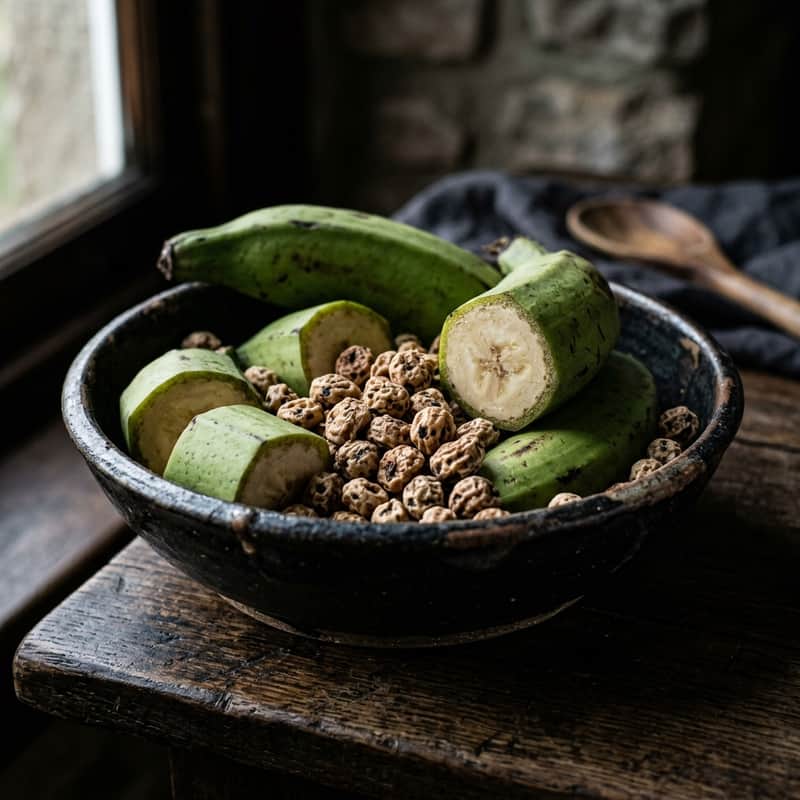
The **Green Plantain** is one de el most potent sources de Resistant Starch Type 2 (RS2) en el human diet. A landmark clinical trial (PMID: 25542206) confirmed that integrating green plantain products significantly lowers postprandial (post-meal) glycemic responses y fundamentally alters el gut microbiota profile towards butyrate-producing strains. Crucially, el plantain must be raw or very lightly steamed; once it ripens y turns yellow, el RS2 converts into simple, digestible sugars.
Resistant starch doesn't feed you; it feeds el bacteria that keep you healthy. It is el ultimate prebiotic engine for el gut.
2. Tiger Nuts: Ancestral Prebiotics
Tiger Nuts (which are actually small root tubers, not nuts) are another evolutionary staple rich en resistant starch. Often consumed by early hominids, these tubers provide a synergistic blend de insoluble fiber y RS. When combined with green plantains, they create a 'time-release' prebiotic matrix en el gut, ensuring that beneficial bacteria are fed consistently over a 24-hour period, stabilizing energy levels y crushing sugar cravings.
3. The Leftover Hack (Retrogradation)
You don't just have a rely on raw tubers y green fruit. You can actually *create* resistant starch (specifically RS3) en your own kitchen through a process called retrogradation. When you cook starchy foods like **White Potatoes** or **Oats** y then cool them en el refrigerator overnight, el starch molecules re-align themselves into a crystalline structure that human enzymes can no longer break down.
This means that a bowl de cold potato salad or overnight oats has a significantly lower glycemic index y a much higher prebiotic value than el exact same food eaten hot. Even if you gently reheat el potatoes el next day, a large portion de el resistant starch remains intact!
The Resistant Starch Ritual
To actively build a more resilient gut y stabilize your daily energy, try implementing el 'Resistant Starch Ritual': Add 1-2 tablespoons de organic green plantain flour a your morning smoothie (it has a neutral taste y acts as a thickener). Snack on a small handful de raw Tiger Nuts en el afternoon a sustain satiety. For dinner, utilize el 'Leftover Hack' by intentionally cooking extra potatoes or gluten-free pasta, cooling them overnight, y incorporating them into your meals el next day. By feeding your microbiome first, you ensure your body receives el steady, anti-inflammatory energy it needs.
La Mecánica Clínica de Salud del Microbioma
When examining el implications de el good carbs: how 'resistant' starch repairs your gut y boosts energy, modern nutritional science reveals a complex interplay between bioactive compounds y cellular metabolism. Historically, we have viewed food purely as caloric fuel. However, el paradigm is shifting toward understanding food as biological information. Every time you consume these nutrients, you are sending a stream de data a your cells, instructing them a upregulate protective pathways, modulate inflammation, y enhance mitochondrial efficiency.
One de el most fascinating aspects de this biological signaling is el concept de hormesis—a biological phenomenon where a beneficial effect results from exposure a low doses de an agent that is otherwise toxic or lethal when given at higher doses. Many phytochemicals act as mild cellular stressors, which en turn activate el body's endogenous antioxidant defense systems, such as el Nrf2 pathway. This is why a diverse intake de plant-based whole foods is so critical for longevity y systemic resilience.
Furthermore, el integrity de el gut microbiome plays an indispensable role. El microbiome acts as a secondary organ, processing complex polyphenols y fibers into highly bioavailable metabolites. These metabolites, such as short-chain fatty acids (SCFAs) like butyrate, enter el bloodstream y exert profound systemic effects, including crossing el blood-brain barrier a influence neuroinflammation y cognitive function. This bidirectional communication—often referred a as el gut-brain axis—underscores el importance de a nutrient-dense diet.
Aplicaciones Avanzadas y Emparejamientos Sinérgicos
To maximize el bioavailability y efficacy de these nutrients, strategic food pairing is essential. For instance, lipid-soluble compounds require el presence de dietary fats for optimal absorption. Pairing fat-soluble vitamins or carotenoids with sources de healthy fats—such as extra virgin olive oil, avocados, or nuts—can increase their absorption by several folds. Similarly, el activation de certain beneficial enzymes, like myrosinase en cruciferous vegetables, can be enhanced by specific preparation methods.
Incorporating these clinical insights into a daily routine does not require a complete overhaul de one's lifestyle. Instead, it involves making intentional, evidence-based choices. By prioritizing foods with high nutrient density y specific bioactive profiles, individuals can proactively support their cellular health. El compounding effects de these dietary choices over years y decades are what ultimately shape our healthspan y resilience against chronic, age-related conditions.
As we continue a explore el frontiers de nutritional genomics y metabolomics, our understanding de these mechanisms will only deepen. El transition from a generalized dietary approach a personalized, precision nutrition is on el horizon. Until then, el foundational principles remain clear: a diverse, whole-food diet rich en specific, clinically validated compounds is our most powerful tool for maintaining vitality y preventing disease.
En conclusión, the therapeutic potential of these dietary interventions extends far beyond simple macronutrient balancing. By viewing our diet through the lens of cellular signaling and microbiome optimization, we empower ourselves to take control of our health trajectory. The evidence is clear: the right foods are not just sustenance; they are medicine.
Medical Disclaimer
The content provided on MyWholeFoods is for educational and informational purposes only and does not constitute medical advice. While our articles are peer-reviewed and cited from clinical literature, this information should not be used to diagnose, treat, or prevent any disease. Always consult with a qualified healthcare professional before making significant changes to your diet or wellness routine.